CS106L Notes
Lecture 1: Welcome
Design Philosophy of C++
Only add features if they solve an actual problem
(C++ 标准委员会(负责语言发展的团队)在添加新特性(如 C++11, 14, 17, 20)时,会要求提案者证明这个新功能能解决一个现实世界中 C++ 程序员正面临的、且现有功能无法很好解决的问题。这就是为什么 C++ 的很多特性(比如 lambda 表达式、智能指针)都直接对应着特定的编程痛点。)
Programmers should be free to choose their own style
Compartmentalization is key
**Allow the programmer full control if they want it
(这是 C++ 最著名(也最危险)的原则之一,常被称为 “你不需要为你不用的东西付出代价”。C++ 提供了非常底层的能力,让你可以直接操控硬件和内存,例如:
- 指针 (Pointers): 允许你直接读写任意内存地址。
- 手动内存管理 (new/delete): 让你精确控制对象的生命周期和它在内存中的位置。
- 内联汇编 (Inline Assembly): 允许你在 C++ 代码中直接嵌入汇编语言指令。
虽然现代 C++ 提供了更安全的替代品(如智能指针 std::unique_ptr),但它从不移除这些底层工具,以备你需要榨干最后一点性能时使用。)
Don’t sacrifice performance except as a last resort
(性能是 C++ 的立身之本。 C++ 的设计目标始终是使其成为运行速度最快的语言之一(与 C 和 Fortran 并驾齐驱)。这条原则意味着,C++ 的许多高级特性被设计为 “零成本抽象” (Zero-Cost Abstractions)。
零成本抽象:指那些让你代码更易读、更安全的高级功能,但在编译后,它们产生的机器码和你自己手写底层 C 风格代码一样高效,不会增加任何运行时的开销。例子:- 模板 (Templates): std::vector
在编译时就会生成一个专门处理 int 的类,其访问效率与 C 语言的 int[] 数组完全相同。 - std::sort 算法: 编译器通常会将其高度优化,运行速度往往比你自己随手写的快速排序更快。)
- 模板 (Templates): std::vector
Enforce safety at compile time whenever possible
Lecture 2: Types and Structs
*
1
auto d = “Hello”; // const char* (a C string)
这样用 `auto` 会被 compiler 推断为一个常量字符串的指针,若想修改字符串中的元素,会有报错。

1
2
:!g++ auto.cpp -o auto -Wall -Wshadow -Wextra -g -lm -O2 -std=c++11 && ./auto
auto.cpp:15:10: error: read-only variable is not assignable
autois a keyword that tells the compiler to deduce the type of a variable, it should be used when the type is obvious or very cumbersome to write out.
Lecture 3: Initialization & References
When do we use references/const references?
- If we’re working with a variable that takes up little space in memory (e.g. int, double), we don’t need to use a reference and can just copy the variable
- If we need to alias the variable to modify it, we can use references
- If we don’t need to modify the variable, but it’s a big
variable (e.g. std::vector), we can use const references
You can return references as well!
1
2
3
4
5
6
7
8
9
10
11
// Note that the parameter must be a non-const reference to return
// a non-const reference to one of its elements!
int& front(std::vector<int>& vec) {
// assuming vec.size() > 0
return vec[0];
}
int main() {
std::vector<int> numbers{1, 2, 3};
front(numbers) = 4; // vec = {4, 2, 3}
return 0;
}
Lecture 4: Streams
Lecture 5: Containers
Container: An object that allows us to collect other objects together and interact with them in some way.
Containers: Sequence and Associative
Sequence: the position of element is up to programmer.
Associative: access elements by keys, underlying core is complex data structure.
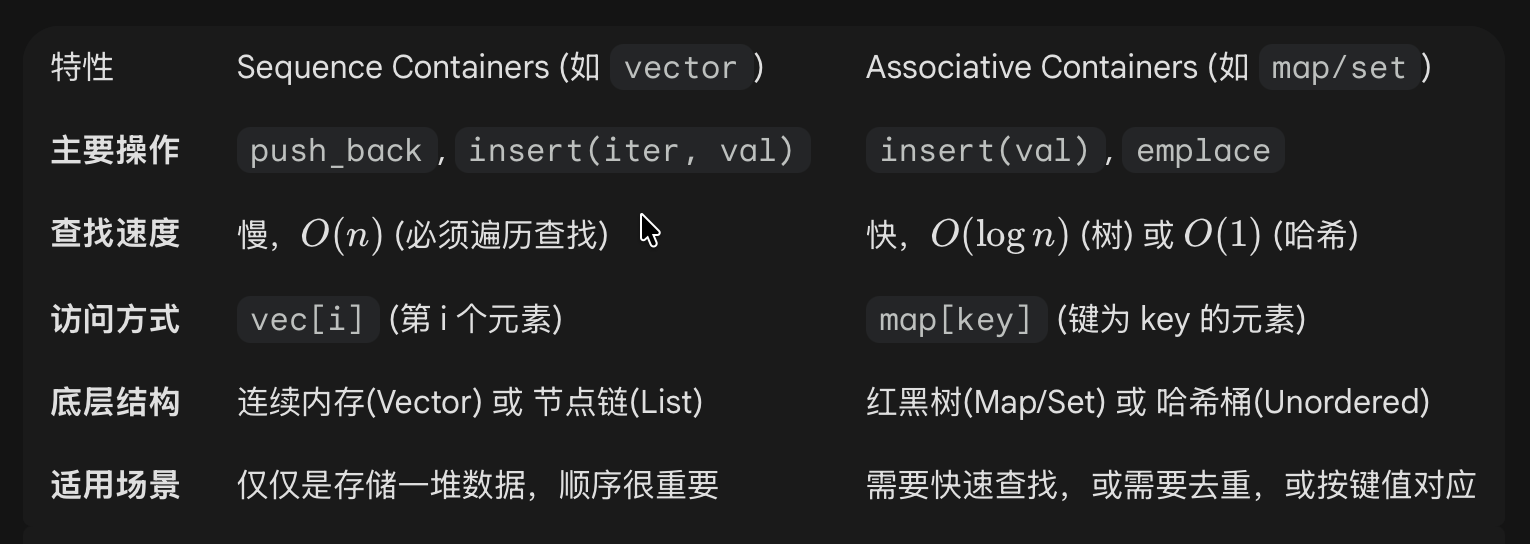
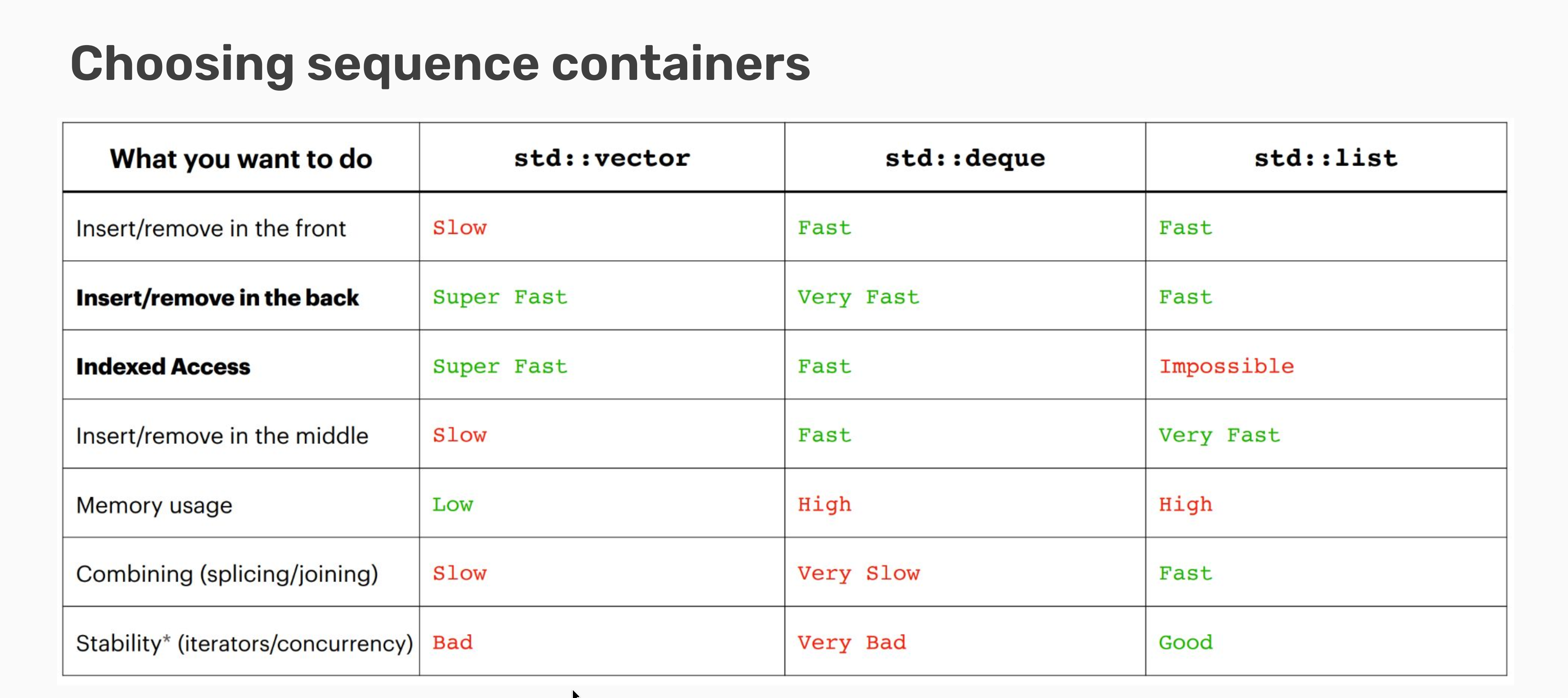
Container Adaptors
Container Adaptors are a “repackaging” of existing containers, which enforce specific data access rules (such as LIFO or FIFO) by limiting their functionality.
e.g.stackis based ondeque,queueis based ondeque,priority_queueis based onvector1
2std::priority_queue<int, std::vector<int>, std::greater<int>> pq;
// for Min-Heap, you cannot skip the intermediate parameters to set the third parameter.
Lecture 6: Iterators and Pointers
Iterators:
vectorare accessed by index,mapby key, andlistcan only be traversed sequentially. Is there a unified method to iterate over all these containers? Iterators.Iterators is a finger pointing to the file cabinet (containers). For any containers, iterators can:
- Dereference: Read/Write the file currently pointed to.
- Increment: Move to the next file.
- Comparison: Check whether we have already moved to the last file.
Iterator Categories
- Forward Iterator: only support
++, e.g.unordered_map,unordered_set. - Bidirectional Iterators: only support
++and--, e.g.map,set,list. - Random Access Iterators: support any random access. e.g.
vector,deque. - no Iterators:
stack,queue,priority_queue.
- Forward Iterator: only support
In Iterator,
++iteris faster thaniter++.
From now on, make a habit of using++iinstead of usingi++!!convinient map iterator loop:
1
2
3
4std::map<int, int> map{{1, 6}, {2, 8}, {0, 3}, {3,9}};
for (auto iter = map.begin(); iter != map.end(); ++iter) {
const auto& [key, value] = *iter; // structured binding!
}Iterators are a particular type of pointers!
Iterators “point” at particular elements in a container, and Pointers can “point” at any objects in your code!Iter->firstIf you have a pointer ptr pointing to an object, you want to access the member variable var of this object.
- old:
(*ptr).var - new:
ptr->var
Iterators are pointers! so when checking elements
[key, value]inmapwe can useIter->firstandIter->second.- old: